Choosing the Perfect Teeth Shade for Your Skin
Avoid the “fake” look! Learn how to choose the perfect teeth shade for your skin. Discover the science of tooth color, bleach shades, and expert tips for 2026.
The most common fear patients have when undergoing a smile makeover isn’t the procedure itself—it’s the result. We have all seen it: a beautiful person with a smile so blindingly white and opaque that it looks like a row of glowing piano keys. This “artificial” look happens because of one critical mistake: ignoring the harmony between the restorations and the person’s unique biology. Choosing the perfect teeth shade for your skin is the most important aesthetic decision you will make during your dental journey.
At Hayat Laviva Clinic, our “Success Together” philosophy is built on the belief that the best dental work is invisible. A successful transformation doesn’t scream “I had veneers”; it whispers “I have beautiful teeth.” Whether you are in London, New York, or traveling to our center in Istanbul, this guide will walk you through the professional secrets of color theory, helping you find a shade that illuminates your face without looking like a costume.
The Science of Tooth Color: It’s Not Just “White”
To master choosing the perfect teeth shade for your skin, you must first understand that natural teeth are not pure white. They are a complex mixture of colors, depths, and translucencies.
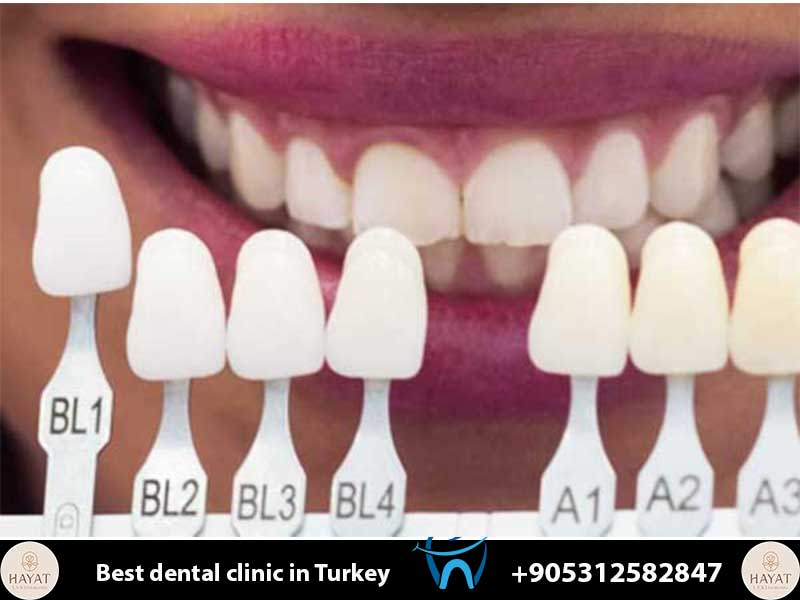
Professional dental shade guides, such as the VITA Classical Shade Guide, categorize tooth colors into four basic ranges:
- A (Reddish-Brownish): The most common natural shade range.
- B (Reddish-Yellowish): Great for patients with warmer skin undertones.
- C (Greyish): Often found in older patients or those with specific genetic traits.
- D (Reddish-Grey): A less common, neutral range.
Within these ranges, there are levels of brightness (1 being the brightest, 4 being the darkest). In the modern era, we also have “Bleach Shades” (0M1, 0M2, 0M3), which go whiter than any natural tooth could ever be.
1. Identify Your Skin Undertone
The secret to choosing the perfect teeth shade for your skin lies in your undertones, not just your surface skin color. Undertones are the permanent colors beneath your skin’s surface.
Cool Undertones
If your veins appear blue/purple and you look better in silver jewelry, you have cool undertones.
- The Best Shade: Look for “A1” or “B1”. You can lean into the brighter, cooler whites without them looking “blue” against your skin. Avoid yellowish shades, as they will look dull.
Warm Undertones
If your veins appear green and you look better in gold jewelry, you have warm undertones.
- The Best Shade: You should choose shades from the “B” category (like B1 or B2). These have a subtle yellow-red base that complements the warmth in your skin, making the teeth look vibrant and healthy rather than “floating” in your mouth.
Neutral Undertones
If you can wear both silver and gold, you are neutral.
- The Best Shade: You have the most flexibility. Most patients in this category find that “A1” provides the most natural, high-end look.
2. The “Eye-White” Rule of Thumb
If you are struggling with choosing the perfect teeth shade for your skin, there is a classic cosmetic dentistry rule: your teeth should never be whiter than the whites of your eyes (the sclera).
If your teeth are significantly brighter than your eyes, the contrast becomes distracting. The human brain perceives this as a “mismatch,” which is why some smiles look “fake” even if the shape of the teeth is perfect. To achieve a high-end, sophisticated result, aim for a shade that matches or is just half a step brighter than your eye-whites.
3. Considering Your Age and Facial Structure
As we age, our teeth naturally darken. This is a look the world is accustomed to. If a 60-year-old patient chooses an “extra-white” bleach shade, the contrast against the natural aging of the skin can look jarring.
- For Mature Patients: Choosing a shade like “A2” or “B2” often provides a “rejuvenation” effect that looks like a natural, healthy version of yourself from 20 years ago.
- For Younger Patients: You can get away with “0M3” or “A1” more easily, as your skin has the elasticity and brightness to handle the high contrast.
Shade Comparison Table: Bleach vs. Natural
| Shade Category | Popular Codes | Visual Effect | Best For… |
| Hollywood Bleach | 0M1, 0M2 | Ultra-white, opaque | Models, influencers, high-contrast skin |
| Natural Bright | 0M3, A1, B1 | Very white but translucent | Most smile makeovers; “fresh” look |
| Classic Natural | A2, B2 | Warm, healthy, creamy | Patients over 40; discrete restorations |
| Deep Natural | A3, B3 | Mature, darker base | Matching existing natural teeth |
4. Translucency: The Secret to “Real” Teeth
Even if you fail at choosing the perfect teeth shade for your skin, high translucency can save the result. Natural teeth are clear at the edges (the incisal edge). This allows light to pass through.
Cheap, monolithic restorations are often “flat” and “opaque.” At Hayat Laviva Clinic, we use layered E-max or high-translucency Zirconia. This ensures that even if you choose a very white shade, the edges remain slightly clear, which breaks up the light and prevents the “blocky” look.
5. Lighting Matters: The Consultation Secret
When choosing the perfect teeth shade for your skin in the clinic, the lighting is often artificial and bright.
- The Tip: Always check your chosen shade under natural sunlight. Ask your coordinator to take you to a window. Artificial LED lights can make “B1” look “A1” and vice versa.
- The Makeup Factor: For women, we recommend coming to the shade-selection appointment with no lipstick. Strong lip colors change the perception of the tooth shade.
Realistic Medical Guidance: Why You Might Want to Go Darker
It sounds counterintuitive, but sometimes “darker is better.” If you are only getting 4 veneers or a few crowns, you must match your existing teeth. Choosing a shade that is too white will make your natural teeth look yellow by comparison.
If you are doing a full-mouth restoration (top and bottom), you have more freedom. However, always remember that “A1” is considered the “Natural White” of the dental world. Anything whiter than A1 enters the “Bleach” territory, which requires a specific personality and style to pull off.
Why Choose Hayat Laviva Clinic for Your Shade Selection?
At Hayat Laviva Clinic, we treat color selection as a medical precision task.
- Digital Color Matching: We don’t just use plastic tabs; we use digital sensors to analyze your natural enamel.
- Expert Aesthetic Designers: Our team understands the “Turkish Smile” vs. the “Natural Smile” and will guide you toward what fits your face, not just the trend.
- Success Together Philosophy: We involve you in every step. You will see a digital mock-up and a physical temporary “trial smile” before the final work is done.
- VIP Concierge: We handle your luxury stay in Istanbul, giving you the peace of mind to focus on these important aesthetic decisions.
🏁 Your Success is in the Details
Choosing the perfect teeth shade for your skin is the difference between a dental procedure and a life-changing transformation. By respecting your undertones, your age, and the “Eye-White” rule, you ensure a result that looks expensive, natural, and timeless.
Ready to find your perfect match? Contact Hayat Laviva Clinic today for a Free Digital Consultation. Send us a photo in natural light, and our experts will help you identify the ideal shade for your unique skin tone.
❓ FAQ: Choosing the Perfect Teeth Shade for Your Skin
1. What is the most natural teeth shade?
For most people, A1 or A2 is considered the most natural shade. It has a balance of brightness and warmth that mimics healthy human enamel.
2. Can I change my mind after the veneers are made?
No. Once the ceramic (E-max or Zirconia) is fired and glazed, the color is permanent. This is why our “Success Together” trial-smile phase is so important.
3. Will my skin tan affect my tooth shade?
Yes. If you have a deep tan or darker skin, white teeth will appear even brighter due to the contrast. Patients with darker skin should be careful with “Bleach” shades to avoid an artificial look.
4. What is the “Hollywood” shade?
The “Hollywood” look usually uses 0M1 or 0M2 bleach shades. They are very white and have lower translucency to ensure they “pop” on camera.
5. Does the material affect the color?
Yes. E-max is more translucent and picks up some of the color of the underlying tooth. Zirconia is more opaque and is better for “masking” very dark natural teeth.
6. Should I whiten my natural teeth before choosing a shade?
Yes! If you are only getting a few veneers, whiten your natural teeth first. We will then match the veneers to your newly whitened shade.
7. How long does it take to choose a shade in Turkey?
At Hayat Laviva Clinic, shade selection is part of your first-day consultation. It takes about 30–60 minutes of careful comparison under different lighting.